
On the international wine scene, the year 2026 marks a historic turning point for Armenia, a land with a millennia-old tradition, which will host the prestigious red, white, and sparkling wine categories of the Concours Mondial de Bruxelles.
From May 21 to 23, the capital Yerevan will serve as the stage where over 370 experts from nearly 50 countries will gather to evaluate thousands of labels from around the world, while also discovering the full range of Armenian wines.
The decision to hold the Concours Mondial in Armenia is significant: not only is it an emerging destination, but it is also a region that boasts the oldest roots in the history of wine (consider, for example, the Areni-1 cave archaeological site, where wine presses and amphorae dating back more than 6,000 years have been discovered). Hosting the Concours Mondial is a recognition of a wine renaissance that combines ancient history, unique biodiversity, and modern winemaking techniques.
In recent years, Armenian wines have been gaining international recognition. The region where they are produced is characterized by high altitudes, volcanic soils, and an extreme continental climate, which gives the wines an unmistakable personality. Armenia’s true strength lies in its wealth of indigenous grape varieties, which offer aromatic profiles that are hard to find elsewhere.
Official video of the global competition in Armenia
Here are the main Armenian grape varieties:
Voskehatz: Considered the “queen of white grapes,” its name, fittingly, means “golden berry.” This is an extremely long-lived grape variety, capable of producing wines with a rich, aromatic bouquet, featuring notes ranging from white flowers to apricots, supported by a pronounced minerality and a vibrant acidity.
Kangoun: A versatile and hardy white grape, highly prized for its freshness. Often vinified on its own or in a blend, it produces fragrant wines with hints of apple, white peach, and a pleasant citrus note.
Areni Noir (or simply Areni): This is the undisputed star of Armenian red wines. Native to the Vayots Dzor region, it produces elegant, fresh, and complex wines, often compared to those of Burgundy for their tannic finesse. It offers hints of wild cherry, red fruits, and spices, and sometimes tertiary notes of leather and tobacco when aged.
Haghtanak: A red-berried grape that yields deep ruby-colored, structured, and rich wines, characterized by generous aromas of wild blackberry and cherry.
The main production areas:
Vayots Dzor is the heart of tradition and is likely the most prestigious and internationally renowned region. Situated at high altitudes (between 1,000 and 1,800 meters), it boasts a climate with mild winters and very sunny days. It is here that the Areni-1 cave complex is located, which is considered the oldest winemaking site in the world (dating back approximately 6,100 years). It is the home of the red-berried Areni Noir grape variety.
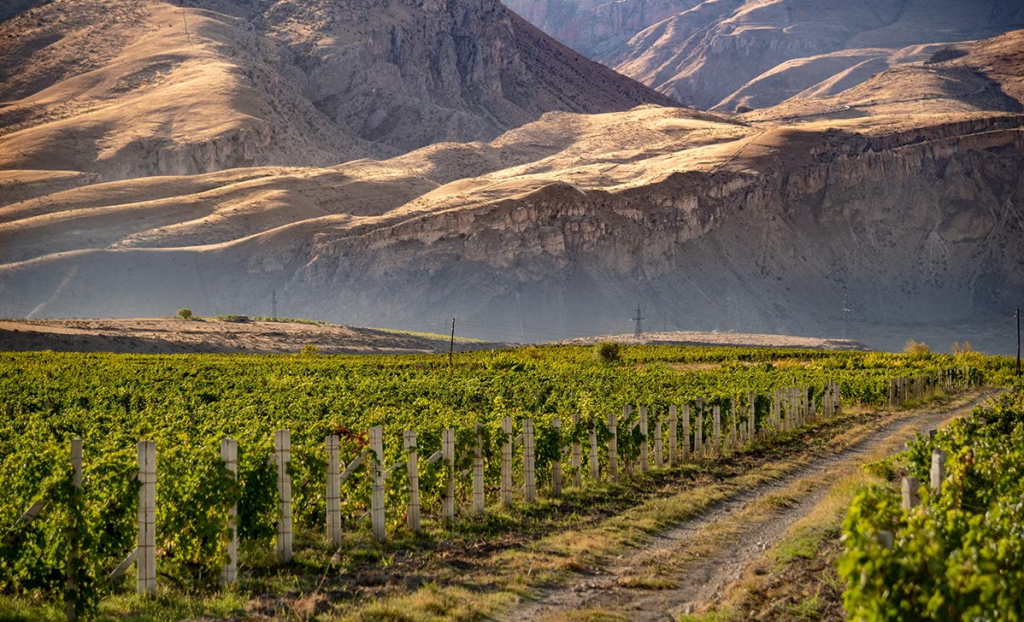
Armavir is the driving force behind production. Located in the west of the country, at the foot of Mount Ararat and Mount Aragats, it is the largest wine-growing province. Situated at an altitude of between 800 and 1,100 meters, it is characterized by deep soils formed from glacial moraines and ample sunlight.
It is a key region for both the production of white wines (using varieties such as Garan Dmak and Mskhali) and the production of the renowned Armenian brandy.
Aragatsotn is the epitome of high-altitude excellence. Located in the northwestern part of the country, this region is renowned for its high-altitude vineyards and the quality of its boutique wineries. The vineyards are located at altitudes between 2,953 and 4,593 feet (900 and 1,400 meters). The soils, which are predominantly of volcanic origin and rich in basalt, tuff, and limestone, impart a distinctive minerality to the wines. In addition to the versatile Voskehats (one of the finest white varieties), producers here are successfully experimenting with international grape varieties (such as Cabernet Sauvignon and Merlot) alongside indigenous ones.
Ararat is the historic valley located in the plain of the same name. Historically, this region has been one of the cornerstones of Armenian winemaking. With altitudes ranging from 800 to 1,000 meters (2,600 to 3,200 feet) and a very sunny semi-desert climate, it is an ideal area for growing grapes that require a lot of warmth. The region is home to numerous traditional indigenous varieties, both white and red, and has been a benchmark for Armenian winemaking for millennia.
Tavush, located in the northeast. This area has a cooler, greener climate and offers a different wine-growing experience, producing wines with more delicate aromatic profiles, often based on local varieties that are less common elsewhere, such as Khatoun Kharji.
Today, Armenian winemaking is experiencing a positive duality. On the one hand, there is the revival of the use of amphorae (Karasi), which harks back to ancestral techniques and imparts natural micro-oxygenation and a unique structural complexity to the wines. On the other hand, the adoption of precision technologies in the winery makes it possible to cleanse the fruit and enhance the varietal character in extremely clean conditions. The wines produced in this setting are often characterized by a distinctive richness , a surprising freshness, and an almost “mystical” connection to the land, offering an authentic tasting experience that recounts millennia of history with every sip.

Ultimately, the arrival of the Concours Mondial de Bruxelles in Armenia is a global invitation to discover a country that is not only returning to winemaking but is also proudly reasserting its position as a leading player in the contemporary wine world.
Established in 1994 with a permanent headquarters in Brussels, the Concours has been held on a traveling basis since 2006. Each year, approximately 15,000 wines from 45 countries around the world are evaluated by a panel of international tasters selected from among journalists, oenologists, agronomists, sommeliers, bloggers, and buyers. Link for wine registration
The tastings will be conducted strictly blind. Each panel of judges will taste around 50 wines per session, using a specially created tasting sheet on a tablet, similar to the OIV sheet. A statistical system developed in collaboration with the Catholic University of Louvain ensures the consistency and reproducibility of the tasters’ assessments.
To this end, some wines will be tasted again by the same panel, as well as by different panels, and there will also be a subsequent check of the award-winning samples to ensure the legitimacy of the results. In fact, a selection of the medal-winning wines will undergo chemical, physical, and sensory analysis in order to compare the sample submitted with the product purchased on the market.


Amazing story thank you for writing this. They are a country of good people who also suffered, like us, because of the Turkish… They deserve respect and appreciation. And of course.. wine should be drunk with responsibility. 😇⭐️